
|
Welcome to ShortScience.org! |



|
- ShortScience.org is a platform for post-publication discussion aiming to improve accessibility and reproducibility of research ideas.
- The website has 1584 public summaries, mostly in machine learning, written by the community and organized by paper, conference, and year.
- Reading summaries of papers is useful to obtain the perspective and insight of another reader, why they liked or disliked it, and their attempt to demystify complicated sections.
- Also, writing summaries is a good exercise to understand the content of a paper because you are forced to challenge your assumptions when explaining it.
- Finally, you can keep up to date with the flood of research by reading the latest summaries on our Twitter and Facebook pages.
Group Normalization
Yuxin Wu and Kaiming He
arXiv e-Print archive - 2018 via Local arXiv
Keywords: cs.CV, cs.LG
First published: 2018/03/22 (8 years ago)
Abstract: Batch Normalization (BN) is a milestone technique in the development of deep learning, enabling various networks to train. However, normalizing along the batch dimension introduces problems --- BN's error increases rapidly when the batch size becomes smaller, caused by inaccurate batch statistics estimation. This limits BN's usage for training larger models and transferring features to computer vision tasks including detection, segmentation, and video, which require small batches constrained by memory consumption. In this paper, we present Group Normalization (GN) as a simple alternative to BN. GN divides the channels into groups and computes within each group the mean and variance for normalization. GN's computation is independent of batch sizes, and its accuracy is stable in a wide range of batch sizes. On ResNet-50 trained in ImageNet, GN has 10.6% lower error than its BN counterpart when using a batch size of 2; when using typical batch sizes, GN is comparably good with BN and outperforms other normalization variants. Moreover, GN can be naturally transferred from pre-training to fine-tuning. GN can outperform its BN-based counterparts for object detection and segmentation in COCO, and for video classification in Kinetics, showing that GN can effectively replace the powerful BN in a variety of tasks. GN can be easily implemented by a few lines of code in modern libraries.
more
less
Yuxin Wu and Kaiming He
arXiv e-Print archive - 2018 via Local arXiv
Keywords: cs.CV, cs.LG
First published: 2018/03/22 (8 years ago)
Abstract: Batch Normalization (BN) is a milestone technique in the development of deep learning, enabling various networks to train. However, normalizing along the batch dimension introduces problems --- BN's error increases rapidly when the batch size becomes smaller, caused by inaccurate batch statistics estimation. This limits BN's usage for training larger models and transferring features to computer vision tasks including detection, segmentation, and video, which require small batches constrained by memory consumption. In this paper, we present Group Normalization (GN) as a simple alternative to BN. GN divides the channels into groups and computes within each group the mean and variance for normalization. GN's computation is independent of batch sizes, and its accuracy is stable in a wide range of batch sizes. On ResNet-50 trained in ImageNet, GN has 10.6% lower error than its BN counterpart when using a batch size of 2; when using typical batch sizes, GN is comparably good with BN and outperforms other normalization variants. Moreover, GN can be naturally transferred from pre-training to fine-tuning. GN can outperform its BN-based counterparts for object detection and segmentation in COCO, and for video classification in Kinetics, showing that GN can effectively replace the powerful BN in a variety of tasks. GN can be easily implemented by a few lines of code in modern libraries.



[link]
If you were to survey researchers, and ask them to name the 5 most broadly influential ideas in Machine Learning from the last 5 years, I’d bet good money that Batch Normalization would be somewhere on everyone’s lists. Before Batch Norm, training meaningfully deep neural networks was an unstable process, and one that often took a long time to converge to success. When we added Batch Norm to models, it allowed us to increase our learning rates substantially (leading to quicker training) without the risk of activations either collapsing or blowing up in values. It had this effect because it addressed one of the key difficulties of deep networks: internal covariate shift. To understand this, imagine the smaller problem, of a one-layer model that’s trying to classify based on a set of input features. Now, imagine that, over the course of training, the input distribution of features moved around, so that, perhaps, a value that was at the 70th percentile of the data distribution initially is now at the 30th. We have an obvious intuition that this would make the model quite hard to train, because it would learn some mapping between feature values and class at the beginning of training, but that would become invalid by the end. This is, fundamentally, the problem faced by higher layers of deep networks, since, if the distribution of activations in a lower layer changed even by a small amount, that can cause a “butterfly effect” style outcome, where the activation distributions of higher layers change more dramatically. Batch Normalization - which takes each feature “channel” a network learns, and normalizes [normalize = subtract mean, divide by variance] it by the mean and variance of that feature over spatial locations and over all the observations in a given batch - helps solve this problem because it ensures that, throughout the course of training, the distribution of inputs that a given layer sees stays roughly constant, no matter what the lower layers get up to. On the whole, Batch Norm has been wildly successful at stabilizing training, and is now canonized - along with the likes of ReLU and Dropout - as one of the default sensible training procedures for any given network. However, it does have its difficulties and downsides. One salient one of these comes about when you train using very small batch sizes - in the range of 2-16 examples per batch. Under these circumstance, the mean and variance calculated off of that batch are noisy and high variance (for the general reason that statistics calculated off of small sample sizes are noisy and high variance), which takes away from the stability that Batch Norm is trying to provide. One proposed alternative to Batch Norm, that didn’t run into this problem of small sample sizes, is Layer Normalization. This operates under the assumption that the activations of all feature “channels” within a given layer hopefully have roughly similar distributions, and, so, you an normalize all of them by taking the aggregate mean over all channels, *for a given observation*, and use that as the mean and variance you normalize by. Because there are typically many channels in a given layer, this means that you have many “samples” that go into the mean and variance. However, this assumption - that the distributions for each feature channel are roughly the same - can be an incorrect one. A useful model I have for thinking about the distinction between these two approaches is the idea that both are calculating approximations of an underlying abstract notion: the in-the-limit mean and variance of a single feature channel, at a given point in time. Batch Normalization is an approximation of that insofar as it only has a small sample of points to work with, and so its estimate will tend to be high variance. Layer Normalization is an approximation insofar as it makes the assumption that feature distributions are aligned across channels: if this turns out not to be the case, individual channels will have normalizations that are biased, due to being pulled towards the mean and variance calculated over an aggregate of channels that are different than them. Group Norm tries to find a balance point between these two approaches, one that uses multiple channels, and normalizes within a given instance (to avoid the problems of small batch size), but, instead of calculating the mean and variance over all channels, calculates them over a group of channels that represents a subset. The inspiration for this idea comes from the fact that, in old school computer vision, it was typical to have parts of your feature vector that - for example - represented a histogram of some value (say: localized contrast) over the image. Since these multiple values all corresponded to a larger shared “group” feature. If a group of features all represent a similar idea, then their distributions will be more likely to be aligned, and therefore you have less of the bias issue. One confusing element of this paper for me was that the motivation part of the paper strongly implied that the reason group norm is sensible is that you are able to combine statistically dependent channels into a group together. However, as far as I an tell, there’s no actually clustering or similarity analysis of channels that is done to place certain channels into certain groups; it’s just done so semi-randomly based on the index location within the feature channel vector. So, under this implementation, it seems like the benefits of group norm are less because of any explicit seeking out of dependant channels, and more that just having fewer channels in each group means that each individual channel makes up more of the weight in its group, which does something to reduce the bias effect anyway. The upshot of the Group Norm paper, results-wise, is that Group Norm performs better than both Batch Norm and Layer Norm at very low batch sizes. This is useful if you’re training on very dense data (e.g. high res video), where it might be difficult to store more than a few observations in memory at a time. However, once you get to batch sizes of ~24, Batch Norm starts to do better, presumably since that’s a large enough sample size to reduce variance, and you get to the point where the variance of BN is preferable to the bias of GN.  |

Efficient Interactive Annotation of Segmentation Datasets with Polygon-RNN++
David Acuna and Huan Ling and Amlan Kar and Sanja Fidler
arXiv e-Print archive - 2018 via Local arXiv
Keywords: cs.CV
First published: 2018/03/26 (8 years ago)
Abstract: Manually labeling datasets with object masks is extremely time consuming. In this work, we follow the idea of Polygon-RNN to produce polygonal annotations of objects interactively using humans-in-the-loop. We introduce several important improvements to the model: 1) we design a new CNN encoder architecture, 2) show how to effectively train the model with Reinforcement Learning, and 3) significantly increase the output resolution using a Graph Neural Network, allowing the model to accurately annotate high-resolution objects in images. Extensive evaluation on the Cityscapes dataset shows that our model, which we refer to as Polygon-RNN++, significantly outperforms the original model in both automatic (10% absolute and 16% relative improvement in mean IoU) and interactive modes (requiring 50% fewer clicks by annotators). We further analyze the cross-domain scenario in which our model is trained on one dataset, and used out of the box on datasets from varying domains. The results show that Polygon-RNN++ exhibits powerful generalization capabilities, achieving significant improvements over existing pixel-wise methods. Using simple online fine-tuning we further achieve a high reduction in annotation time for new datasets, moving a step closer towards an interactive annotation tool to be used in practice.
more
less
David Acuna and Huan Ling and Amlan Kar and Sanja Fidler
arXiv e-Print archive - 2018 via Local arXiv
Keywords: cs.CV
First published: 2018/03/26 (8 years ago)
Abstract: Manually labeling datasets with object masks is extremely time consuming. In this work, we follow the idea of Polygon-RNN to produce polygonal annotations of objects interactively using humans-in-the-loop. We introduce several important improvements to the model: 1) we design a new CNN encoder architecture, 2) show how to effectively train the model with Reinforcement Learning, and 3) significantly increase the output resolution using a Graph Neural Network, allowing the model to accurately annotate high-resolution objects in images. Extensive evaluation on the Cityscapes dataset shows that our model, which we refer to as Polygon-RNN++, significantly outperforms the original model in both automatic (10% absolute and 16% relative improvement in mean IoU) and interactive modes (requiring 50% fewer clicks by annotators). We further analyze the cross-domain scenario in which our model is trained on one dataset, and used out of the box on datasets from varying domains. The results show that Polygon-RNN++ exhibits powerful generalization capabilities, achieving significant improvements over existing pixel-wise methods. Using simple online fine-tuning we further achieve a high reduction in annotation time for new datasets, moving a step closer towards an interactive annotation tool to be used in practice.
|
[link]
In this paper, the authors develop a system for automatic as well as an interactive annotation (i.e. segmentation) of a dataset. In the automatic mode, bounding boxes are generated by another network (e.g. FasterRCNN), while in the interactive mode, the input bounding box around an object of interest comes from the human in the loop. The system is composed of the following parts: https://github.com/davidjesusacu/polyrnn-pp/raw/master/readme/model.png 1. **Residual encoder with skip connections**. This step acts as a feature extractor. The ResNet-50 with few modifications (i.e. reducing stride, usage of dilation, removal of average pooling and FC layers) serve as a base CNN encoder. Instead of utilizing the last features of the network, the authors concatenate outputs from different layers - resized to highest feature resolution - to capture multi-level representations. This is shown in the figure below: https://www.groundai.com/media/arxiv_projects/226090/x4.png.750x0_q75_crop.png 2. **Recurrent decoder** is a two-layer ConvLSTM which takes image features, previous (or first) vertex position and outputs one-hot encoding of 28x28 representing possible vertex position, +1 indicates that the polygon is closed (i.e. the end of the sequence). Attention weight per location is utilized using CNN features, 1st and 2nd layers of ConvLSTM. Training is formulated as reinforcement learning since recurrent decoder is considered as sequential decision-making agent. The reward function is IoU between mask generated by the enclosed polygon and ground-truth mask. 3. **Evaluator network** chooses the best polygon among multiple candidates. CNN features, last state tensor of ConvLSTM, and the predicted polygon are used as input, and the output is the predicted IoU. The best polygon is selected from the polygons which are generated using 5 top scoring first vertex predictions. https://i.imgur.com/84amd98.png 4. **Upscaling with Graph Neural Network** takes the list of vertices generated by ConvLSTM decode, adds a node in between two consecutive nodes (to produce finer details at higher resolution), and aims to predict relative offset of each node at a higher resolution. Specifically, it extracts features around every predicted vertex and forwards it through GGNN (Gated Graph Neural Network) to obtain the final location (i.e. offset) of the vertex (treated as classification task). https://www.groundai.com/media/arxiv_projects/226090/x5.png.750x0_q75_crop.png The whole system is not trained end-to-end. While the network was trained on CityScapes dataset, it has shown reasonable generalization to different modalities (e.g. medical data). It would be very nice to observe the opposite generalization of the model. Meaning you train on medical data and see how it performs on CityScapes data. |

Taskonomy: Disentangling Task Transfer Learning
Amir Zamir and Alexander Sax and William Shen and Leonidas Guibas and Jitendra Malik and Silvio Savarese
arXiv e-Print archive - 2018 via Local arXiv
Keywords: cs.CV, cs.AI, cs.LG, cs.NE, cs.RO
First published: 2018/04/23 (8 years ago)
Abstract: Do visual tasks have a relationship, or are they unrelated? For instance, could having surface normals simplify estimating the depth of an image? Intuition answers these questions positively, implying existence of a structure among visual tasks. Knowing this structure has notable values; it is the concept underlying transfer learning and provides a principled way for identifying redundancies across tasks, e.g., to seamlessly reuse supervision among related tasks or solve many tasks in one system without piling up the complexity. We proposes a fully computational approach for modeling the structure of space of visual tasks. This is done via finding (first and higher-order) transfer learning dependencies across a dictionary of twenty six 2D, 2.5D, 3D, and semantic tasks in a latent space. The product is a computational taxonomic map for task transfer learning. We study the consequences of this structure, e.g. nontrivial emerged relationships, and exploit them to reduce the demand for labeled data. For example, we show that the total number of labeled datapoints needed for solving a set of 10 tasks can be reduced by roughly 2/3 (compared to training independently) while keeping the performance nearly the same. We provide a set of tools for computing and probing this taxonomical structure including a solver that users can employ to devise efficient supervision policies for their use cases.
more
less
Amir Zamir and Alexander Sax and William Shen and Leonidas Guibas and Jitendra Malik and Silvio Savarese
arXiv e-Print archive - 2018 via Local arXiv
Keywords: cs.CV, cs.AI, cs.LG, cs.NE, cs.RO
First published: 2018/04/23 (8 years ago)
Abstract: Do visual tasks have a relationship, or are they unrelated? For instance, could having surface normals simplify estimating the depth of an image? Intuition answers these questions positively, implying existence of a structure among visual tasks. Knowing this structure has notable values; it is the concept underlying transfer learning and provides a principled way for identifying redundancies across tasks, e.g., to seamlessly reuse supervision among related tasks or solve many tasks in one system without piling up the complexity. We proposes a fully computational approach for modeling the structure of space of visual tasks. This is done via finding (first and higher-order) transfer learning dependencies across a dictionary of twenty six 2D, 2.5D, 3D, and semantic tasks in a latent space. The product is a computational taxonomic map for task transfer learning. We study the consequences of this structure, e.g. nontrivial emerged relationships, and exploit them to reduce the demand for labeled data. For example, we show that the total number of labeled datapoints needed for solving a set of 10 tasks can be reduced by roughly 2/3 (compared to training independently) while keeping the performance nearly the same. We provide a set of tools for computing and probing this taxonomical structure including a solver that users can employ to devise efficient supervision policies for their use cases.
|
[link]
The goal of this work is to perform transfer learning among numerous tasks and to discover visual relationships among them. Specifically, while we intiutively might guess the depth of an image and surface normals are related, this work takes a step forward and discovers a beneficial relationship among 26 tasks in terms of task transferability - many of them are not obvious. This is important for scenarios when an insufficient budget is available for target task for annotation, thus, learned representation from the 'cheaper' task could be used along with small dataset for the target task to reach sufficient performance on par with fully supervised training on a large dataset. The basis of the approach is to compute an affinity matrix among tasks based on whether the solution for one task can be sufficiently easily used for another task. This approach does not impose human intuition about the task relationships and chooses task transferability based on the quality of a transfer operation in a fully computational manner. The task taxonomy (i.e. **taskonomy**) is a computationally found directed hypergraph that captures the notion of task transferability over any given task dictionary. It performed using a four-step process depicted in the figure below: 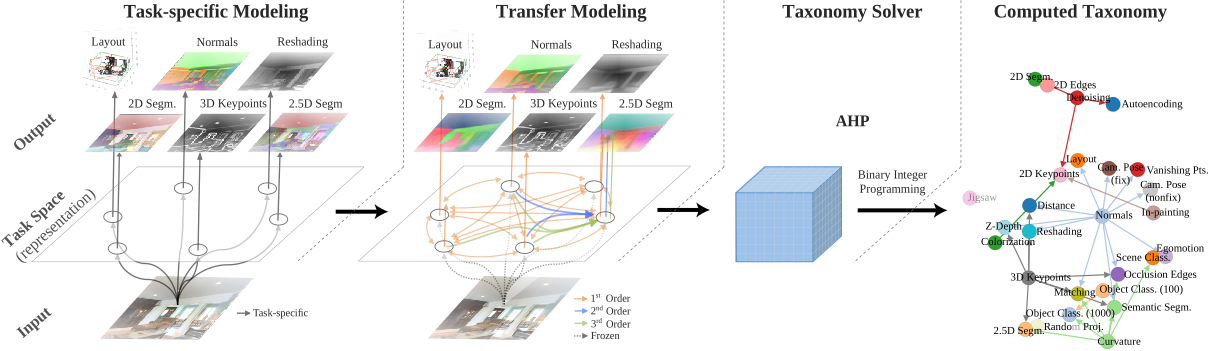 - In stage I (**Task-specific Modelling**), a task-specific network is trained in a fully supervised manner. The network is composed of the encoder (modified ResNet-50), and fully convolutional decoder for pixel-to-pixel tasks, or 2-3 FC layers for low-dimensional tasks. Dataset consists of 4 million images of indoor scenes from about 600 buildings; every image has an annotation for every task. - In stage II (**Transfer modeling**), all feasible transfers between sources and targets are trained (multiple inputs task to single target transfer is also considered). Specifically, after the task-specific networks are trained in stage I, the weights of an encoder are fixed (frozen network is used to extract representations only) and the representation from the encoder is used to train a small readout network (similar to a decoder from stage I) with a new task as a target (i.e. ground truth is available). In total, about 3000 transfer possibilities are trained. - In stage III (**Taxonomy solver**), the task affinities acquired from the transfer functions performance are normalized. This is needed because different tasks lie in different spaces and transfer function scale. This is performed using ordinal normalization - Analytical Hierarchy Process (details are in the paper - Section 3.3). This results in an affinity matrix where a complete graph of relationships is completely normalized and this graph quantifies a pair-wise set of tasks evaluated in terms of a transfer function (i.e. task dependency). - In stage IV (**Computed Taxonomy**), a hypergraph which can predict the performance of any transfer policy and optimize for the optimal one is synthesized. This is solved using Binary Integer Program as a subgraph selection problem where tasks are nodes and transfers are edges. After the optimization process, the solution devices a connectivity that solves all target tasks, maximizes their collective performance while using only available source tasks under user-specified constraints (e.g. budget). So, if you want to train your network on an unseen task, you can obtain pretrained weights for existing tasks from the [project page](https://github.com/StanfordVL/taskonomy/tree/master/taskbank), train readout functions against each task (as well as combination of multiple inputs), build an affinity matrix to know where your task is positioned against the other ones, and through subgraph selection procedure observe what tasks have favourable influence on your task. Consequently, you can train your task with much less data by utilizing representations from the existing tasks which share visual significance with your task. Magnificent! |
Born Again Neural Networks
Tommaso Furlanello and Zachary C. Lipton and Michael Tschannen and Laurent Itti and Anima Anandkumar
arXiv e-Print archive - 2018 via Local arXiv
Keywords: stat.ML, cs.AI, cs.LG
First published: 2018/05/12 (8 years ago)
Abstract: Knowledge distillation (KD) consists of transferring knowledge from one machine learning model (the teacher}) to another (the student). Commonly, the teacher is a high-capacity model with formidable performance, while the student is more compact. By transferring knowledge, one hopes to benefit from the student's compactness. %we desire a compact model with performance close to the teacher's. We study KD from a new perspective: rather than compressing models, we train students parameterized identically to their teachers. Surprisingly, these {Born-Again Networks (BANs), outperform their teachers significantly, both on computer vision and language modeling tasks. Our experiments with BANs based on DenseNets demonstrate state-of-the-art performance on the CIFAR-10 (3.5%) and CIFAR-100 (15.5%) datasets, by validation error. Additional experiments explore two distillation objectives: (i) Confidence-Weighted by Teacher Max (CWTM) and (ii) Dark Knowledge with Permuted Predictions (DKPP). Both methods elucidate the essential components of KD, demonstrating a role of the teacher outputs on both predicted and non-predicted classes. We present experiments with students of various capacities, focusing on the under-explored case where students overpower teachers. Our experiments show significant advantages from transferring knowledge between DenseNets and ResNets in either direction.
more
less
Tommaso Furlanello and Zachary C. Lipton and Michael Tschannen and Laurent Itti and Anima Anandkumar
arXiv e-Print archive - 2018 via Local arXiv
Keywords: stat.ML, cs.AI, cs.LG
First published: 2018/05/12 (8 years ago)
Abstract: Knowledge distillation (KD) consists of transferring knowledge from one machine learning model (the teacher}) to another (the student). Commonly, the teacher is a high-capacity model with formidable performance, while the student is more compact. By transferring knowledge, one hopes to benefit from the student's compactness. %we desire a compact model with performance close to the teacher's. We study KD from a new perspective: rather than compressing models, we train students parameterized identically to their teachers. Surprisingly, these {Born-Again Networks (BANs), outperform their teachers significantly, both on computer vision and language modeling tasks. Our experiments with BANs based on DenseNets demonstrate state-of-the-art performance on the CIFAR-10 (3.5%) and CIFAR-100 (15.5%) datasets, by validation error. Additional experiments explore two distillation objectives: (i) Confidence-Weighted by Teacher Max (CWTM) and (ii) Dark Knowledge with Permuted Predictions (DKPP). Both methods elucidate the essential components of KD, demonstrating a role of the teacher outputs on both predicted and non-predicted classes. We present experiments with students of various capacities, focusing on the under-explored case where students overpower teachers. Our experiments show significant advantages from transferring knowledge between DenseNets and ResNets in either direction.
|
[link]
A finding first publicized by Geoff Hinton is the fact that, when you train a simple, lower capacity module on the probability outputs of another model, you can often get a model that has comparable performance, despite that lowered capacity. Another, even more interesting finding is that, if you take a trained model, and train a model with identical structure on its probability outputs, you can often get a model with better performance than the original teacher, with quicker convergence. This paper addresses, and tries to specifically test, a few theories about why this effect might be observed. One idea is that the "student" model can learn more quickly because getting to see the full probability distribution over a well-trained models outputs gives it a more valuable signal, specifically because the trained model is able to better rank the classes that aren't the true class. For example, if you're training on Imagenet, on an image of a huskies, you're only told "this is a husky (1), and not one of 100 other classes, which are all 0". Whereas a trained model might say "'this is most likely a husky, but the probability of wolf is way higher than that of teapot". This inherently gives you more useful signal to train on, because you’re given a full distribution of classes that an image is most like. This theory goes by the name of the “Dark Knowledge” theory (a truly delightful name), because it pulls all of this knowledge that is hidden in a 0/1 label into the light. An alternative explanation for the strong performance of distillation techniques is that the student model is just benefitting from the implicit importance weighting of having a stronger gradient on examples where the teacher model is more confident. You could think of this as leading the student towards examples that are the most clear or unambiguous examples of a class, rather than more fuzzy and uncertain ones. Along with a few other tests (which I won’t address here, for sake of time and focus), the authors design a few experiments to test these possible mechanisms of action. The first test involved doing an explicit importance weighting of examples according to how confident the teacher model is, but including no information about the incorrect classes. The second was similar, but instead involved perturbing the probabilities of the classes that weren’t the max probability. In this situation, the student model gets some information in terms of the overall magnitudes of the not-max class, but can’t leverage it as usefully because it’s been randomized. In both situations, they found that there still was some value - in other words, that the student outperformed the teacher - but it outperformed by less than the case where the teacher could see the full probability distribution. This supports the case that both the inclusion of probabilities for the less probable classes, as well as the “confidence weighting” effect of weighting the student to learn more from examples on which the “teacher” model was more confident. |
Progress & Compress: A scalable framework for continual learning
Jonathan Schwarz and Jelena Luketina and Wojciech M. Czarnecki and Agnieszka Grabska-Barwinska and Yee Whye Teh and Razvan Pascanu and Raia Hadsell
arXiv e-Print archive - 2018 via Local arXiv
Keywords: stat.ML, cs.LG
First published: 2018/05/16 (8 years ago)
Abstract: We introduce a conceptually simple and scalable framework for continual learning domains where tasks are learned sequentially. Our method is constant in the number of parameters and is designed to preserve performance on previously encountered tasks while accelerating learning progress on subsequent problems. This is achieved by training a network with two components: A knowledge base, capable of solving previously encountered problems, which is connected to an active column that is employed to efficiently learn the current task. After learning a new task, the active column is distilled into the knowledge base, taking care to protect any previously acquired skills. This cycle of active learning (progression) followed by consolidation (compression) requires no architecture growth, no access to or storing of previous data or tasks, and no task-specific parameters. We demonstrate the progress & compress approach on sequential classification of handwritten alphabets as well as two reinforcement learning domains: Atari games and 3D maze navigation.
more
less
Jonathan Schwarz and Jelena Luketina and Wojciech M. Czarnecki and Agnieszka Grabska-Barwinska and Yee Whye Teh and Razvan Pascanu and Raia Hadsell
arXiv e-Print archive - 2018 via Local arXiv
Keywords: stat.ML, cs.LG
First published: 2018/05/16 (8 years ago)
Abstract: We introduce a conceptually simple and scalable framework for continual learning domains where tasks are learned sequentially. Our method is constant in the number of parameters and is designed to preserve performance on previously encountered tasks while accelerating learning progress on subsequent problems. This is achieved by training a network with two components: A knowledge base, capable of solving previously encountered problems, which is connected to an active column that is employed to efficiently learn the current task. After learning a new task, the active column is distilled into the knowledge base, taking care to protect any previously acquired skills. This cycle of active learning (progression) followed by consolidation (compression) requires no architecture growth, no access to or storing of previous data or tasks, and no task-specific parameters. We demonstrate the progress & compress approach on sequential classification of handwritten alphabets as well as two reinforcement learning domains: Atari games and 3D maze navigation.
|
[link]
Proposes a two-stage approach for continual learning. An active learning phase and a consolidation phase. The active learning stage optimizes for a specific task that is then consolidated into the knowledge base network via Elastic Weight Consolidation (Kirkpatrick et al., 2016). The active learning phases uses a separate network than the knowledge base, but is not always trained from scratch - authors suggest a heuristic based on task-similarity. Improves EWC by deriving a new online method so parameters don’t increase linearly with the number of tasks. Desiderata for a continual learning solution: - A continual learning method should not suffer from catastrophic forgetting. That is, it should be able to perform reasonably well on previously learned tasks. - It should be able to learn new tasks while taking advantage of knowledge extracted from previous tasks, thus exhibiting positive forward transfer to achieve faster learning and/or better final performance. - It should be scalable, that is, the method should be trainable on a large number of tasks. - It should enable positive backward transfer as well, which means gaining improved performance on previous tasks after learning a new task which is similar or relevant. - Finally, it should be able to learn without requiring task labels, and ideally, it should even be applicable in the absence of clear task boundaries. Experiments: - Sequential learning of handwritten characters of 50 alphabets taken from the Omniglot dataset. - Sequential learning of 6 games in the Atari suite (Bellemare et al., 2012) (“Space Invaders”, “Krull”, “Beamrider”, “Hero”, “Stargunner” and “Ms. Pac-man”). - 8 navigation tasks in 3D environments inspired by experiments with Distral (Teh et al., 2017). |